The check has 24 items: 4 in each of 6 areas. We wrote the items for this application, and the application chooses the numbers, so a classmate may get other numbers than you. No grade is given: the check only shows where to practise.
Example
Before you start, the map is empty: six areas, each with four grey squares. A first item: 3 kg of apples cost € 6. How many euros does 1 kg cost? You type 2, because 6÷3=2.
Definition
Six areas of four items
The areas are Numbers and operations, Fractions, decimals and percentages, Ratio, Measures and shapes, Relations and graphs and Data and chance. The items go from a sum with the order of operations to the mean of five numbers and the chance of a marble. Each area has 4 items.
Example
Here is one item from each area. 7+5×4=27; 25 percent of 4 is 1; 3 kg for € 6 is € 2 for 1 kg; a rectangle 9 cm by 6 cm has a perimeter of 30 cm; after 5, 9, 13, 17 comes 21; the mean of 4, 8, 2, 2, 9 is 5.
Rule
Type the answer, then press Check
Every item asks for a number. Type it in the field next to Answer (the unit stands behind the field) and press Check or Enter. A decimal can be typed with a point or a comma, and a fraction like 3/4 is read too. After a wrong answer the application shows how to get the right one. Next item goes on, and the stepper Item goes to any item from 1 to 24. The timer is off unless you press Timer on.
Example
Work out 7.6+8. You type 15.6 and press Check, because 7.6+8=15.6.
Definition
My map: three bands
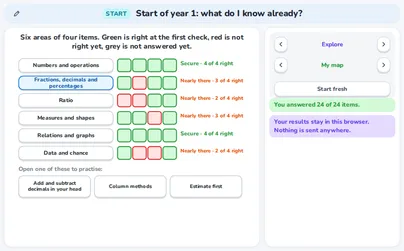
Open the tab My map. Each area is a row of four squares: green is right at your first check, red is not right yet and grey is not answered. When all four are answered the row gets a band: Secure for 4 right, Nearly there for 3 or 2 right and To practise for 1 or 0 right. Before that the row only says how many of the 4 are answered.
Example
Right answers per area: 4, 3, 1, 2, 4, 0, so 14 in all. So 2 areas are secure, 2 nearly there and 2 to practise, and 2+2+2=6.
Watch out!
There is no grade
The check gives no grade, no percentage and no score for you as a person. Four items in an area are too few for a mark: one slip or one lucky guess changes a lot. The three bands only show where it is worth practising.
Example
Two pupils both have 12 of 24 right. The first has 4, 4, 4, 0, 0 and 0 right in the six areas, the second has 2, 2, 2, 2, 2 and 2. The first is secure in three areas and has three to practise; the second is nearly there in all six. The same total, two different maps, so a total says little.
Rule
The map opens the right application
Tap the name of an area in My map. If its band is Nearly there or To practise, 3 buttons appear under Open one of these to practise:. A button opens another application, in the same window; the applications of the items you missed come first. The Back button of the browser brings you back, and your results are still there. A Secure area has no buttons.
Example
In the area Numbers and operations you got everything right except the temperature item. The buttons are Below zero, Sign rules and Four operations, one family: the applications of that item.
Rule
Again: eight new items
The tab Again gives 8 new items from the areas that are not Secure yet, the ones To practise first. An item from the check or from an earlier round does not come back in the same session. New eight starts a new round; the stepper Item goes from 1 to 8. If all six areas are secure, the eight items come from all six.
Example
Right answers per area: 4, 4, 1, 3, 4, 4. Only Ratio (to practise) and Measures and shapes (nearly there) are not secure, so the eight items are 4 from Ratio and 4 from Measures and shapes, and 4+4=8.
Tip
Say it: a card to read aloud
The tab Say it puts your map in plain sentences, one for each band that has an area, such as “Strong: …”, “Nearly there: …” and “To practise: …”. Read the card aloud or show it to your teacher or a parent. Nothing is sent anywhere: the card stays on your screen.
Example
With the map of the earlier card the card says: “Strong: Numbers and operations and Relations and graphs. Nearly there: Fractions, decimals and percentages and Measures and shapes. To practise: Ratio and Data and chance.”
Definition
Where your results live
Your answers are kept in sessionStorage, a small memory of this browser tab. They are not sent to a server and no account is needed. When you close the tab the results are gone; Start fresh in the tab My map clears them at once. A link of the map opens another application in the same tab, so your results are still there when you come back. A new tab starts with an empty map.
Example
You answer 6 items and press a button of the map. When you come back the 6 answers are on the map. You close the tab and open the check again: the map is empty, and your 6 answers were never sent.
Tip
Guess first and Practice
In Guess first you choose between statements about the check, for example whether it gives a grade (it does not). Practice has three levels, Starter, Explorer and Champion, which change the numbers of the same 24 items. There are 10 kinds of question: 6 typed ones (one for each area), one in which you choose the area of an item and three about the check.
Example
The item “Work out 7+5×4.” belongs to the area Numbers and operations. A typed question asks for 7+5×4=27; the choice question asks which area the item belongs to.
Definition
A slip looks right
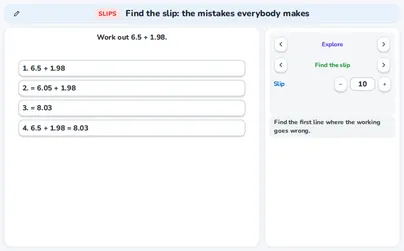
A slip is a mistake that is easy to make and easy to miss, because every line looks neat. In Find the slip you get a worked solution of 4 lines with one slip in it. The lines before the slip are right; the slip and every line after it carry the wrong number on. The 40 slips are original: we wrote them for this application, and the application chooses the numbers.
Example
3+4×2 is 11, because the multiplication comes first. A solution that adds first writes = 7×2 in line 2 and ends at 14. Line 1 is right, line 2 has the slip, and lines 3 and 4 carry the 14 on.
Rule
Find the slip in three steps
1. Tap the line you think has the slip; the application says whether that line is right, or whether the slip is earlier. 2. Choose the kind of slip from the ten chips. 3. Type what the line should show next to This line should show: and press Check. A number or a fraction like 3/4 is read. The application then shows the corrected line.
Example
For the solution of 21+31 you tap line 2, choose Fractions and type 5/6, because 21+31=63+62=65. The corrected line is = 63+62. The slip gave 2/5, which is smaller than 1/2.
Definition
Ten kinds of slips
The ten chips name the kinds: Order, Signs, Place value, Units, The question, Fractions, Percentages, Powers, Averages and Patterns. Each kind has 4 slips, so there are 40 in all. The slip stands in line 1, 2 or 3, never in the last line. The next ten cards show one slip of each kind.
Example
10 kinds of 4 slips make 10×4=40. A worked solution has 4 lines; the slip stands in line 1, 2 or 3 and the last line shows the answer that the slip gives.
Watch out!
Order of operations
This slip reads from left to right and adds before it multiplies. The rule is that multiplication and division come before addition and subtraction, unless brackets say otherwise. In Why it looks right the slip’s way and the right way stand side by side.
Example
For 3+4×2 the slip writes = 7×2=14. The right way is 4×2=8 first and then 3+8=11, so line 2 should show = 3+8.
Watch out!
Signs of numbers
This slip subtracts the two numbers as if both were above zero. Below zero, taking away more goes further down, so −3−2 is −5. The other slips of this kind drop a minus sign, keep the minus in a product of two negative numbers, or add and put a minus on the answer.
Example
For −3−2 the slip works out 3−2=1 and keeps the minus sign, so it gets −1. Taking away 2 from −3 goes down to −5. The corrected line puts the minus sign in front of 3+2, which gives −3−2=−5.
Watch out!
Place value and decimals
Count the decimal places. One decimal place times one decimal place gives two decimal places, so 5×5=25 becomes 0.25. This slip puts the point back after one place only. The other slips of this kind line up the last digits instead of the points, multiply as if the point were not there, or halve where the sum divides by 0.5.
Example
For 0.5×0.5 first 5×5=25. The right line is = 25÷100=0.25. The slip writes = 25÷10=2.5, which is bigger than 0.5: half of a half cannot be bigger than a half.
Watch out!
Units and scale
This slip uses the wrong number of small units in a big one: kilo means a thousand, so 1 km is 1 000 m. The other slips of this kind divide by 10 instead of 100 to go from centimetres to metres on a map, write minutes as hundredths of an hour, or say that 1 m² is 100 cm².
Example
Write 4 km in metres. The slip starts with 1km=100m and gets 400 m. The right first line is 1km=1000m, and then 4×1000=4000m.
Watch out!
The question that was asked
This slip answers another question than the one that was asked: the area instead of the perimeter. The other slips of this kind multiply where “times as many” asks for dividing, round down where the left-over eggs need one more box, or subtract the discount again where the price before the discount is asked.
Example
A rectangle is 5 cm long and 2 cm wide. The perimeter goes all the way around: P = 5+2+5+2=14cm. The slip writes P = 5×2=10cm, which is the area in cm².
Watch out!
Fractions
This slip adds the tops and adds the bottoms. Fractions can only be added when they have the same bottom number, so first find equal bottoms. The other slips of this kind multiply where dividing by a fraction is meant, add the same number to the top and the bottom, or turn the fraction upside down.
Example
For 21+31 the slip adds the tops and the bottoms and gets 2/5. With equal bottoms the sum is 63+62=65. Check: 2/5 is smaller than 1/2, so it cannot be the sum of 1/2 and 1/3.
Watch out!
Percentages
A percentage is always a part of some amount. When a price goes up by 10 percent and then down by 10 percent, the second 10 percent is of the new, higher price, so you do not get back to the start. The other slips of this kind add the percentage as if it were euros, divide by the percentage, or stop at the decimal number.
Example
A price of € 100 goes up by 10 percent and then down by 10 percent. Going up, 100+10=110. Going down, 10 percent of 110 is 11, so 110−11=99. The slip takes 10 off again and ends at 100.
Watch out!
Powers and roots
A square means a number times itself, not times 2. The other slips of this kind multiply by 3 for a cube, halve for a square root, or square the whole product where only the number before the 2 is squared.
Example
For 42 the slip writes = 4×2=8. A square is 4×4=16. For 2 the two agree, because 2×2=22. So a slip can be right by luck.
Watch out!
Averages and chance
The mean is the sum divided by how many numbers there are. This slip divides by one less. The other slips of this kind take the middle of the list without putting the numbers in order, add the largest and smallest value for the range, or compare red marbles with blue ones instead of with all the marbles.
Example
The mean of 4, 4, 8, 20: the sum is 4+4+8+20=36. The slip divides by 3 and gets 12; there are 4 numbers, so 36÷4=9. Check back with 12×4=48, not 36.
Watch out!
Patterns and equations
A pattern does not start at 0: multiplying the step by the place forgets the first number. Test a rule on a number you already know before you trust it. The other slips of this kind put brackets round both steps of a rule, take a difference of distances as the speed, or add where an equation asks for taking away.
Example
5, 7, 9, 11, … What is the 10th number? The slip writes 10×2=20. The right way is 5+9×2=23. On the 4th number the right rule gives 5+3×2=11, but the slip gives 4×2=8.
Tip
Why it looks right, and My slips
In Why it looks right the slip’s way and the right way stand side by side, with one sentence about the idea behind the slip and an easy case to try yourself. In My slips every slip is a button: red means you fell for it, green means you found it at the first try. Try a slip again opens one you fell for. The results stay in this browser tab only; Start fresh clears them.
Example
A pupil found 25 slips at the first try, fell for 6 and has not tried 9, so 25+6+9=40. The 6 red slips are the ones to try again.
Rule
Make a slip
In Make a slip you build the slip yourself. Six lines lie ready as tiles: some belong to the solution with the slip and some to the right solution. Put the lines of the solution with the slip in order, line 1 first, and press Check. The application tells you if you made the slip, if you built the right solution (“no slip”), or if the lines are not a whole solution yet.
Example
For 21+31 the solution with the slip has 4 lines (the first line and the three lines of the slip, so 1+3=4) and the right solution has 3 (the first line and two right lines, so 1+2=3). The six tiles are the first line, the two right lines and the three slipped lines, so 1+2+3=6.
Tip
Year 1 star! (quiz)
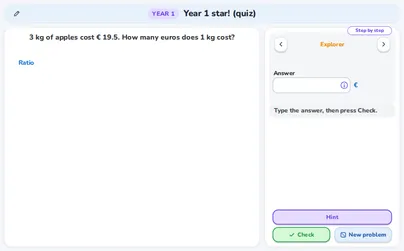
The quiz is practice only. Every question is new and comes from the check or from the slips, at three levels (Starter, Explorer and Champion). The slips have 9 kinds of question: 5 typed ones (the value of the corrected line, the number of the line with the slip, the right answer, the answer that the slip gives and an easy case) and 4 in which you choose the true sentence. Starter asks fewer kinds than Champion. Stuck? Press Hint, then Next step and Show answer.
Example
A typed question: “Which answer does the slip give?” For 3+4×2 the slip adds first and gives 14; the right answer is 11. The answer of the slip is never in the hint or in the steps.
Tip
Class round
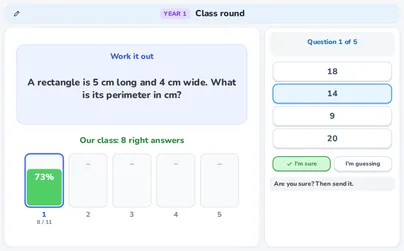
A round has 5 questions for the whole class at once: a definition, a rule, a true-or-myth statement and two sums, one item of the check and one answer that a slip gives. The bank holds 14 questions (4 definitions, 4 rules and 6 true-or-myth statements). Every wrong option has a trap name, such as “adds first”, that the teacher sees.
Example
Work out 2+3×4. The right answer is 14, because 3×4=12 and 2+12=14. A pupil who adds first gets 2+3=5 and 5×4=20; that wrong option carries the trap name “adds first”, which the teacher sees.
Tip
Keys, and nothing is sent
Everything can be done with the keyboard. Tab moves to the next button, chip or field; Enter (or a click) presses a button or a chip, and in a field it checks the answer. In Make a slip Enter moves a tile to the line, the arrow keys move it along the line or to another place, and Esc puts it back. Nothing you type is sent anywhere: every answer is checked in your browser, and the results of the check and of the slips stay in this browser tab only.
Example
In Make a slip: Tab to the first tile, Enter puts it on the line, the arrow keys move it, Esc puts it back. In the tab Find the slip the ten chips and the field work with Tab and Enter too.
Exercises
A pupil has 4, 3, 4, 1, 2 and 4 items right in the six areas. How many areas are secure, nearly there and to practise? Easy
Show solution
4 right is Secure: three areas have 4 right.
3 or 2 right is Nearly there: two areas.
1 right is To practise: one area.
Answer → 3 secure, 2 nearly there, 1 to practise
Check → 3+2+1=6 areas.
In the check a pupil gets an item wrong, reads the explanation and then types the right answer. What does the map show for that item? Easy
Show solution
Only the first check of an item goes on the map.
The first check was wrong, so the square of that item stays red.
The right answer afterwards helps you to learn the item, but it does not change the square.
Answer → a red square (not right yet)
Check → the application says it too: “Only your first check of an item goes on the map.”
In the tab Squares and roots a pupil answers 132=169, 73=343 and says that the square root of 225 is 14. Which answers are right? Easy
Show solution
13×13=169, so the first answer is right.
7×7×7=343, so the second answer is right.
15×15=225, so the square root of 225 is 15 and not 14.
Answer → the first two are right; the square root of 225 is 15
Check → 14×14=196, not 225.
Find the slip in this solution: 1. 3−(−2) 2. = 3−2 3. = 1 4. 3−(−2)=1. Which line has the slip, what kind is it and what should the line show? Easy
Show solution
Line 1 is the sum itself, so it is right.
In line 2 the minus sign of −2 is dropped. Taking away a negative number is the same as adding it.
The kind is Signs. The line should show = 3+2, which is 5.
Answer → line 2, Signs, = 3+2 so 5 (the slip gives 1)
Check → 3−(−2)=3+2=5, and 5 is more than 3: taking away a number below zero makes more.
All six areas are secure. How many of the eight items of Again come from each area? Easy
Show solution
If every area is secure, Again uses all six areas, in the order of the map, and goes round them.
The first six items give one item to each area.
Items 7 and 8 go round again to the first two areas: Numbers and operations and Fractions, decimals and percentages.
Answer → two items from each of the first two areas, one from each of the other four
Check → 2+2+1+1+1+1=8.
Two pupils both have 12 of 24 items right. The first has 4 right in three areas and none right in the other three. The second has 2 right in every area. What are their maps? Medium
Show solution
The first pupil: three areas with 4 right are Secure, three areas with 0 right are To practise.
The second pupil: 2 right is Nearly there in all six areas.
The totals are the same, but the first pupil should start with three areas, the second pupil has to look at every area for slips.
Answer → first: 3 secure and 3 to practise; second: 6 nearly there
Check → 3⋅4=12 and 6⋅2=12, so the same total.
A worked solution of 0.5×0.5 has four lines. 1. 0.5×0.5 2. 5×5=25 3. = 25÷10=2.5 4. 0.5×0.5=2.5. Which line has the slip, what kind is it and what should it show? Medium
Show solution
Lines 1 and 2 are right, since 5×5=25.
In line 3 the point is put back after one place. Two factors with one decimal place each give two decimal places.
The kind is Place value. The line should show = 25÷100=0.25.
Answer → line 3, Place value, = 25÷100=0.25 (the slip gives 2.5)
Check → 0.5 is a half, and a half of a half is a quarter, 0.25. The 2.5 of the slip is bigger than 0.5.
A price of € 100 goes up by 10 percent and then goes down by 10 percent. What is the price at the end, and how much did the price change? Medium
Show solution
Up: 10 percent of 100 is 10, so 100+10=110.
Down: 10 percent of 110 is 11, so 110−11=99.
The change is 100−99=1.
Answer → € 99, € 1 less than at the start
Check → 100×1011×109=99.
In the tab Squares and roots a pupil answers four numbers: right in 4 s, right in 2 s, a wrong answer, right in 7 s. The limits are 3 and 6 seconds. What colour does each answer get? Medium
Show solution
Green is up to 3 seconds, yellow up to 6 seconds, red after that or when the answer is wrong.
4 seconds is yellow and 2 seconds is green.
The wrong answer is red, and 7 seconds is more than 6, so it is red too.
Answer → yellow, green, red, red
Check → a number that is not green comes back 3 times as often as a green one, so the red and yellow numbers are asked more.
In the area Fractions, decimals and percentages a pupil misses the decimal sum 7.6+8 and the item “Write 1/2 as a decimal number”, and gets the other two right. Which three buttons does the map show? Medium
Show solution
The area has 2 right, so it is Nearly there: buttons appear.
The applications of the missed items come first, in the order of the items, without repeating one. The decimal sum gives Add and subtract decimals in your head, Column methods and Estimate first.
The other missed item would add Fractions in everyday life and The fraction wall, but only three buttons fit.
Answer → Add and subtract decimals in your head, Column methods, Estimate first
Check → the three buttons are the three applications of the first missed item.
A worked solution of 21+31 has four lines. 1. 21+31 2. = (1+1)/(2+3) 3. = 2/5 4. 21+31=52. Give the line, the kind, the corrected line and the right answer, and say how you can see without calculating that 2/5 is wrong. Hard
Show solution
Line 2 adds the tops and the bottoms. The kind is Fractions.
With equal bottoms 21=63 and 31=62, so the corrected line is = 63+62 and the right answer is 63+62=65.
The sum of 1/2 and another positive fraction is more than 1/2, but 52=0.4 is less.
Answer → line 2, Fractions, = 63+62, 5/6
Check → 21<65 and 52<21, so the slip’s answer is too small.
Find the slip in the solution for the mean of 4, 4, 8 and 20: 1. 4, 4, 8, 20 2. 4+4+8+20=36 3. 36÷3=12 4. → 12. Which line has it, what kind is it, and how can you check backwards that 12 cannot be the mean? Hard
Show solution
Lines 1 and 2 are right: the sum is 36.
Line 3 divides by 3, but there are 4 numbers, and 36÷4=9. The kind is Averages.
Check backwards: a mean of 12 for 4 numbers means a sum of 12×4=48, but the sum is 36.
Answer → line 3, Averages, 36÷4=9
Check → 9×4=36.
The numbers go 5, 7, 9, 11, … A solution writes “10×2=20” for the 10th number. What is the slip, what is the right 10th number, and how do the two rules do on the 4th number, which is 11? Hard
Show solution
The slip multiplies the step 2 by the place 10 and forgets the start 5. The kind is Patterns.
The right rule: the 10th number is 9 steps after the first, so 5+9×2=23.
On the 4th number the right rule gives 5+3×2=11, which is right. The rule of the slip gives 4×2=8, which is not.
Answer → Patterns; the 10th number is 23; the rule of the slip fails on the 4th number
Check → the 9th number is 5+8×2=21, and 21+2=23.
A slip writes n2 as n×2. For which whole numbers n from 1 to 20 does it give the right answer? And a slip that writes n3 as n×3, for n from 1 to 10? Hard
Show solution
n2=n×2 means n×n=n×2. Divide both sides by n and you get n=2. For n=2 it works because 22=4=2×2, but 32=9 and 3×2=6.
n3=n×3 means n×n=3 after dividing by n, and no whole number multiplied by itself gives 3, because 1×1=1 and 2×2=4. So no n works for the cubes.
Answer → only n=2 for the squares; no n for the cubes
Check → 22=4=2×2. A slip can be right by luck, so one right answer does not show that the method is right.
For 21+31 six tiles lie ready in Make a slip. Order A is the first line and the two right lines, order B the first line and the three lines of the slip, order C the first line, one right line and one line of the slip. What does the application say about A, B and C? Hard
Show solution
A uses 1+2=3 tiles: it is the right solution, and the application says that this solution has no slip.
B uses 1+3=4 tiles: it is the solution with the slip, and the application says that you made a slip of the kind Fractions.
C mixes a right line and a line of the slip: that is not a whole solution yet.
Answer → A: no slip; B: a slip of the kind Fractions; C: not a whole solution yet
Check → 1+2=3 tiles for A, 1+3=4 tiles for B, and 1+2+3=6 tiles in all.
Interactive applications for this topic
Free applications open with a free student account. Teachers can use all applications in a live lesson.