İnteraktif Dersler

Say why: explain the working, estimates and structure

Lecture notes

Definition

Say why: a step and its reason

To say why is to give two things: the step you took and the reason it works. “I added 400 and took 2 off” is a step. “Because 398 is 2 less than 400” is the reason. The reason is what makes it an explanation.
Example
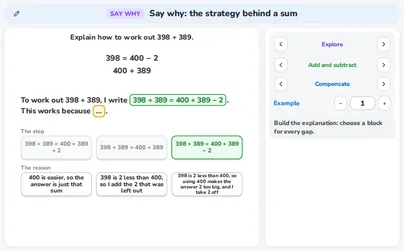
To work out I write . This works because 398 is 2 less than 400, so using 400 makes the answer 2 too big.
Definition

Build the explanation from word blocks

In the applications you build the explanation from word blocks. The sentence has two gaps, The step and The reason, and every gap has 3 blocks: one is right and two are classic mistakes. A right block turns green and fills the gap. A wrong block turns red and a card tells what went wrong and how to put it right. The application checks every block, so a reason that you choose counts as saying why.
Example
The gap The step for holds (right), and . Only the first is a true equation → .
Rule

Say it out loud or in writing

The blocks check your thinking; they do not replace talking. In class say it out loud or write it in your own words: “I did …, because …”. Free writing and speaking stay with the teacher: the application never reads what you say or write, and nothing you do is stored.
Example
“I did first, because 398 is almost 400.” The teacher listens for the step and for the reason (398 is 2 less than 400).
Rule

Jump: add in parts

Jump: keep the first number and add the second number in parts, like jumps on an empty number line. The reason is that adding in parts gives the same total as adding all at once.
Example
, because . The jumps +400, +70 and +8 lead from 370 to 770, 840 and 848.
370770840848+400+70+8
Rule

Split and by columns: places together

Split: cut both numbers into places and add the places that belong together: hundreds with hundreds, tens with tens, ones with ones. By columns does the same one place at a time and adds the answers of the places at the end.
Example
. By columns → , because ones.
Rule

Column method: carry a full place

In the column method you add the ones, then the tens, then the hundreds. When a place is full (10 or more), ten of that place make one of the next place: write the ones and carry 1 to the next place. The reason is that ten ones make one ten.
4765351011+11carry
Example
→ , so write 1 and carry 1 ten. → write 1 and carry 1. → write 0 and carry 1. The answer is 1 011.
Rule

Compensate: round, then correct

Compensate: change a number into a round number that is close, work with it, then correct the difference at the end. If you made the number bigger the answer is too big and you take the difference off; if you made it smaller you add it.
Example
. 400 is 2 more than 398, so is 2 too big.
389789787+400−2
Rule

Analogy and reshape

Analogy: use a sum you know and think about the places → is like , ten times as big. Reshape: take from one number what you add to the other. The total stays the same.
Example
, because 90 is 9 tens and 60 is 6 tens. → 2 is added to 7 198 and 2 is taken from 2 939.
Rule

Add up and find the difference

A subtraction is the gap between two numbers. Add up: count the gap upwards in easy jumps and add the jumps. Find the difference: when the two numbers are close together, the answer is the small gap between them.
Example
→ , so the answer is . , because .
6 8216 8306 9007 000+9+70+100
Rule

Swap and inverse

Swap: change the order when that is easier. The order of an addition, and of a multiplication, does not matter. Inverse: adding and subtracting undo each other, and so do multiplying and dividing, so you can check a subtraction by adding.
Example
→ start with the big number. , because .
Rule

Multiplying: repeat, double, halve

Multiplication has its own ways. Repeat → is 34 added 7 times. Double: to multiply by 4 double twice. Halve: to multiply by 5 multiply by 10 and halve. Double and halve: halve one number and double the other, and the product stays the same.
Example
. , because 5 is half of 10. .
Rule

Split a number: the area picture

Split a number: cut one number into easy parts and multiply each part. An area picture shows why: the whole rectangle is the parts put together. 6 groups of 59 are 6 groups of 50 and 6 groups of 9.
Example
. In the picture the rectangle 6 by 59 is cut into 6 by 50 and 6 by 9.
300505496596 × 59 = 300 + 54 = 354
Rule

Column method for a product: carry the tens

In the column method for a product you multiply digit by digit from the right and carry the tens. The reason is the same as for adding: 56 is 5 tens and 6 ones, so you write the 6 and carry the 5.
Example
→ , write 6 and carry 5. , write 1 and carry 6. . The answer is 6 216.
88876216×56carry
Rule

Division: repeat the subtraction and inverse

Repeat the subtraction: take the divisor away again and again until what is left is less than the divisor. The number of times is the answer and what is left is the remainder. Inverse: dividing undoes multiplying, so , because .
Example
→ take 7 away 17 times and 1 is left, so . The 1 is less than 7, so no more groups of 7 fit.
Tip

Choose the best way

There is often more than one good way. Choose the way with the fewest steps for these numbers: a number just below a round number asks for compensating, two numbers close together ask for the difference, and numbers with nothing special ask for the column method.
Example
(compensate). (the difference → ). has nothing special: use the column method, 7 176.
Definition

An estimate: round, calculate, say what the rounding did

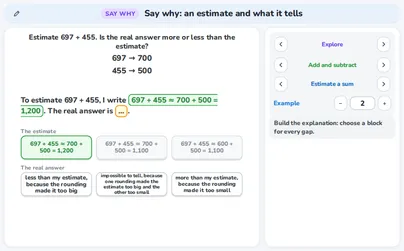
An estimate is a quick calculation with rounded numbers. Round each number to its first digit, calculate with the rounded numbers, and then say whether the real answer is more or less. If both numbers were rounded down, the real sum is more than the estimate.
434−34400++818−18800≈= 1 200= 1 2521 252 > 1 200
Example
. Both numbers were rounded down, so the real answer is more than 1 200: it is 1 252.
Rule

A difference: look at each number

For a difference, look at each number. Rounding the first number up makes the difference bigger, and rounding the second number down makes it bigger too. When both roundings make the estimate bigger, the real answer is less than the estimate.
986+141 000−−310−10300≈= 700= 676676 < 700
Example
. 986 was rounded up and 310 was rounded down: both make the estimate too big. The real answer, 676, is less than 700.
Watch out!

Careful: roundings in opposite directions

When one number goes up and the other goes down, the roundings pull in opposite directions. Then you cannot tell from the rounding alone whether the real answer is more or less. The right thing to say is that you cannot tell.
76+480++33−330≈= 110= 109109 < 110
Example
→ 76 went up, 33 went down, and the real answer, 109, is less. → 74 went down, 38 went up, and the real answer, 112, is more.
74−470++38+240≈= 110= 112112 > 110
Rule

A product and a quotient

For a product, a number rounded down makes the estimate too small, so the real product is more. For a quotient, a bigger divisor gives a smaller quotient. Round to numbers that divide easily, and ask for each number what the rounding did.
909××32−230≈= 270= 288288 > 270
Example
→ 32 was rounded down, so the real product, 288, is more. → 725 went down and 57 went up, both make the quotient smaller, so the real answer, 12.7, is more.
725−5720÷÷57+360≈= 12= 12.712.7 > 12
Rule

Correct a product

You can correct an estimate to get the exact answer. Round one number, multiply, and then take off (or add) what the rounding changed: every group is a little too big or a little too small.
Example
. Each of the 7 groups is 2 too big, so 280 is too big. .
707××38+240≈= 280= 266266 < 280
Rule

Correct a quotient

For a quotient, think about the divisor. A smaller divisor gives a bigger quotient. If the real divisor is bigger than the one you used, the real answer is less than your estimate.
Example
. 31 is bigger than 30, so dividing by 31 gives less: the real answer is less than 38 (it is 36.8).
1 14001 140÷÷31−130≈= 38= 36.836.8 < 38
Rule

Compensate with decimals

Compensating works with decimals too. Change the decimal into a whole number that is close, work with it, and then correct the small difference at the end.
Example
. 18 is 0.1 more than 17.9, so the answer 63.6 is 0.1 too big and you take 0.1 off.
45.663.663.5+18−0.1
Rule

Line up the places

When you add or subtract decimals, the same places must stand under each other. Write the missing zeros so that every number has the same number of decimals: 6.5 is the same as 6.50.
Example
. Now the tenths stand under the tenths and the hundredths under the hundredths.
6,503,772,73−
Rule

Add up to a whole number

Subtract by adding up: the answer is the gap from the smaller number up to the bigger one. With decimals, first jump to the next whole number, then jump the rest.
Example
→ and , so the answer is .
2.2235+0.78+2
Rule

Estimate with decimals

To estimate with decimals, round to whole numbers (or to an easy decimal such as 0.2 when you divide) and say what the rounding did. A bigger divisor gives a smaller quotient, so a divisor that went up makes the estimate smaller.
9.4−0.49++5.15−0.155≈= 14= 14.5514.55 > 14
Example
→ both went down, so the real answer is more than 14. → the divisor went up, so the estimate is too small and the real answer is more than 33 000.
6 60006 600÷÷0.19+0.010.2≈= 33 000= 34 736.834 736.8 > 33 000
Rule

Is the money enough?

To know whether the money is enough, round the prices up. If even that total is not more than the money you have, the money is enough. To see that it is not enough, round down.
Example
You have 100 and want 8 things at 11.05 each. , and 96 is not more than 100, so the money is enough. The real total is 88.40.
808××11.05+0.9512≈= 96= 88.488.4 < 96
Rule

The better buy: the price of one

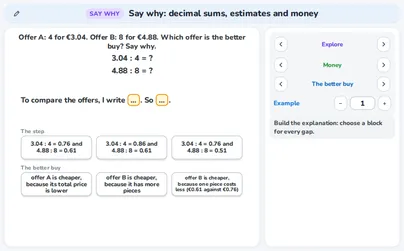
To compare offers, find the price of one piece: divide each price by the number of pieces. The smaller price for one piece is the better buy.
Example
Offer A is 4 for 3.04 → . Offer B is 8 for 4.88 → . 0.61 is less than 0.76, so B is the better buy.
Rule

A total that cannot be right

Estimate the total with round prices. Every price is rounded by less than a half, so the real total is close to the estimate. A total on a receipt that is far from the estimate cannot be right.
Example
. A receipt that says 30.37 is about 10 more than the estimate, so it cannot be right. The real total is 20.37.
Definition

Every place is ten times the next

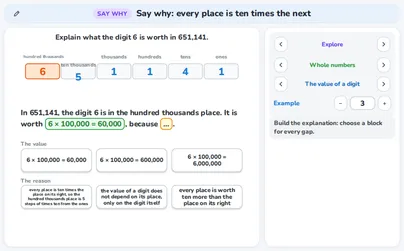
Every place is worth ten times the place on its right. To find what a digit is worth, count the steps from the ones place: every step to the left is another factor of 10.
1001017487 × 100 = 700
Example
In 748 the 7 is in the hundreds place → , because each step to the left is ten times as much (ones, tens, hundreds).
Rule

Ten make one in the next place

When ten of one place are collected they make one of the next place on the left: 10 ones make 1 ten and 10 tens make 1 hundred. That is why a full place is carried in a column sum.
Example
and → ten tens make one hundred. → ten hundreds make one thousand.
Rule

Times ten and times a hundred

Multiplying by ten makes every digit worth ten times as much, so every digit moves one place to the left. Zeros fill the empty places. Times a hundred moves every digit two places.
10010151510× 10
Example
and → the 5 and the 1 move left and zeros fill the places they leave.
10³100101515100× 100
Rule

After the point: tenths and hundredths

After the point the places get ten times smaller to the right: tenths, hundredths, thousandths. Ten hundredths make one tenth. A digit after the point is worth the digit times 0.1, 0.01 or 0.001.
10.1477 × 0.1 = 0.7
Example
→ ten hundredths make one tenth. In 4.7 the 7 is in the tenths place and is worth .
Rule

Divide by ten and by a hundred

Dividing by ten makes every digit worth ten times less, so every digit moves one place to the right. The point stays where it is. Dividing by a hundred moves every digit two places.
1010.16262÷ 10
Example
and → the digits move right and the point stays.
1001010.10.01340340÷ 100
Rule

Big numbers and the zeros of a power of ten

The rule keeps working far to the left. In a big number count the places from the right. Every zero of a power of ten is one more place, so one more factor of ten.
10⁸10⁷10⁶10⁵10⁴10³1001013201313992 × 10 000 000 = 20 000 000
Example
In 320 131 399 the 2 is in the ten millions place → . 10 000 000 has 7 zeros, so it is → seven tens multiplied together.
Rule

Compare two fractions

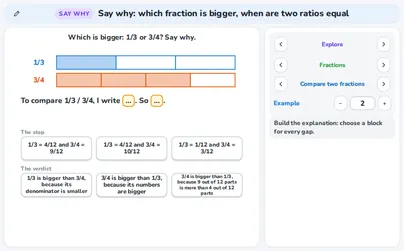
To compare two fractions, give them the same denominator (the same size of parts) and then compare the numerators (how many parts).
1/2=2/4<3/4
Example
1/2 and 3/4 → . 3 parts of 4 is more than 2 parts of 4, so 3/4 is bigger than 1/2.
Rule

Equal fractions: the same factor on both parts

Two fractions are equal when the ratio of the numerator to the denominator is the same. Multiply the numerator and the denominator by the same number and the fraction stays equal. Adding the same number to both does not keep it equal.
1/4=2/8=3/12
Example
→ both parts times 2, both parts times 3. But add 1 to both parts of 1/4 and you get 2/5, which is more than 1/4.
1/4<2/5
Rule

A part of a total: fraction and percentage

A part of a total is a fraction. Write it with the denominator 100 and you have the percentage: 40/100 is 40 percent.
20/50=40/100
Example
20 out of 50 is , so 40 percent. The 50 is doubled to 100, so the 20 is doubled to 40.
Watch out!

Two groups: more objects is not a bigger share

A bigger number of objects does not always mean a bigger share. Compare the shares, not the numbers of objects: write both as a percentage and compare those.
30%>20%
Example
Group A: 3 out of 10 children cycle, . Group B: 8 out of 40, . Group B has more cyclists (8 against 3), but group A has the bigger share.
Definition

Line symmetry: the fold line

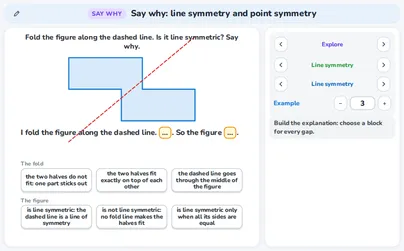
A figure is line symmetric when you can fold it along a line so that the two halves fit exactly on top of each other. The fold line is the line of symmetry. A line through the middle is not always a line of symmetry.
✔the halves fit on each other
Example
A rectangle that is not a square has 2 lines of symmetry: the vertical and the horizontal line through the middle. Its diagonal is not one: after folding along it a part sticks out.
✘a part sticks out
Definition

Point symmetry: the half turn

A figure is point symmetric when a half turn around a dot makes the figure cover itself exactly. The dot is the centre of symmetry. A half turn is half of a full turn.
✔after a half turn it fits exactly
Example
A parallelogram is point symmetric: a half turn about its middle covers it exactly. It has no line of symmetry: folding along a line through the middle leaves parts sticking out.
✘a part sticks out
Tip

Say it in words: lines, centre or neither

To say why in words, name the fold line or the centre and say what happens: “the halves fit” or “a part sticks out”. A figure can have lines and a centre, only lines, only a centre, or neither.
✔after a half turn it fits exactly
Example
A rectangle: 2 lines and a centre. An isosceles triangle: 1 line and no centre, because after a half turn a part sticks out. A parallelogram and an S-shaped figure: a centre and no line.
✘after a half turn a part sticks out
Tip

The quiz and the class round

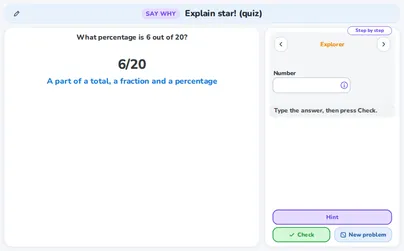
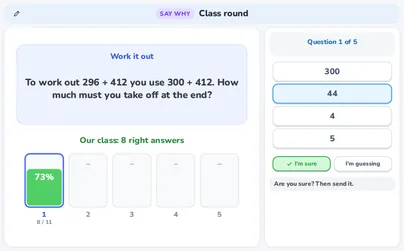
The quiz Explain star! mixes the questions of the six applications at three levels. The class round gives the whole class 5 questions at once: words, rules and true-or-myth statements, and sums where every wrong answer has a trap with a name.
Example
A question of the round: “Every place is worth … the place on its right.” The right answer is “ten times”; “a hundred times” is a place off and “ten more than” adds instead of multiplying.
Tip

Keys, nothing is sent, and our own pictures

The blocks work with a click or a tap and also by keyboard: Tab goes to the next block and Enter chooses it. The arrow buttons of the choosers work the same way. Nothing you choose or type is sent anywhere and nothing is stored: when the page closes, the work is gone. Every picture and situation is our own, and the numbers are new every time.
Example
Press Tab until a block has an outline, then Enter: the block turns green or red. Do the same for the second gap.

Exercises

A pupil works out as . Say why this works. Easy
Show solution
298 is 2 less than 300, so working with 300 gives 2 too much.
is 2 too big, so take 2 off.
So .
Answer → 443
Check → .
Which way is the quickest for ? Say why. Easy
Show solution
The two numbers are close together, so find the difference.
Count the gap upwards → .
4 9965 003+7
The answer is the small gap: 7.
Answer → find the difference, 7
Check → and , and .
Estimate with the first digits. Is the real answer more or less than the estimate? Say why. Easy
Show solution
Round each number to its first digit: 347 becomes 300 and 229 becomes 200.
.
347−47300++229−29200≈= 500= 576576 > 500
Both numbers were rounded down, so the real sum is more than 500.
Answer → about 500, and the real answer is more
Check → , which is more than 500.
In 3 506, what is the 5 worth? Say why. Easy
Show solution
Count from the ones place: 6 ones, 0 tens, 5 hundreds.
10³10010135065 × 100 = 500
The 5 is in the hundreds place, and every step to the left is ten times as much.
So the 5 is worth .
Answer → 500
Check → .
Write 1/3 with the denominator 12. Say why the fraction stays equal. Easy
Show solution
12 is 4 times 3, so multiply the denominator by 4.
Multiply the numerator by 4 as well, so that the ratio of numerator to denominator stays the same → .
So .
1/3=4/12
Answer → 4/12
Check → because .
Say why . Medium
Show solution
98 is 2 less than 100, so 7 groups of 98 are 7 groups of 100 with 7 groups of 2 taken away.
and .
.
Answer → 686
Check → .
Estimate . Is the real answer more or less than your estimate? Then correct the estimate. Medium
Show solution
Round 47 to 50 → .
808××47+350≈= 400= 376376 < 400
47 was rounded up, so the estimate is too big: the real answer is less than 400.
Each of the 8 groups is 3 too big, so 400 is too big → .
Answer → 376, less than 400
Check → .
You have 25 and want 3 things that cost 6.95 each. Is the money enough? Say why. Medium
Show solution
Round the price up: 6.95 becomes 7.
.
303××6.95+0.057≈= 21= 20.8520.85 < 21
Even with the price rounded up the total, 21, is not more than 25, so the money is enough.
Answer → yes, the money is enough
Check → , which is less than 25.
Say why . Medium
Show solution
Dividing by 100 makes every digit worth a hundred times less.
Every digit moves two places to the right and the point stays: 3 hundreds become 3 ones and 4 tens become 4 tenths.
1001010.10.01340340÷ 100
So .
Answer → 3.4
Check → .
A pupil says: “The diagonal of a rectangle that is not a square is a line of symmetry.” Is that right? Say why. Medium
Show solution
Fold the rectangle along the diagonal in your mind: the corners that are not on the line must land on corners.
They do not: a part sticks out, because the two sides that meet at a corner on the diagonal have different lengths.
✘a part sticks out
So the diagonal is not a line of symmetry. The 2 lines of symmetry are the vertical and the horizontal line through the middle.
Answer → no, it is not right
Check → fold along the vertical line through the middle: the halves fit exactly.
Work out by doubling and halving. Say why the product stays the same. Hard
Show solution
Halve 36 and double 25 → , because two groups of 25 make one group of 50, so only half as many groups are needed.
Do it again → .
.
Answer → 900
Check → .
Estimate . Is the real answer more or less than the estimate? Say why. Hard
Show solution
Round to numbers that divide easily: 58 becomes 60, and .
4 56004 560÷÷58+260≈= 76= 78.678.6 > 76
The divisor went up (58 to 60) and a bigger divisor gives a smaller quotient, so the estimate is too small.
So the real answer is more than 76.
Answer → about 76, and the real answer is more
Check → , which is less than 4 560, so 76 groups of 58 are not enough.
Offer A: 6 notebooks for 4.50. Offer B: 10 notebooks for 7.20. Which is the better buy? Say why. Hard
Show solution
Find the price of one notebook. In A it is .
In B it is .
0.72 is less than 0.75, so one notebook costs less in B: B is the better buy.
Answer → offer B
Check → , which is less than 4.50.
In 20 340 108, what is the 3 worth? Say why. Hard
Show solution
Count the places from the right: ones 8, tens 0, hundreds 1, thousands 0, ten thousands 4, hundred thousands 3.
The 3 is in the hundred thousands place, and every step to the left is ten times as much, so it is .
10⁷10⁶10⁵10⁴10³100101203401083 × 100 000 = 300 000
.
Answer → 300 000
Check → 100 000 has 5 zeros, so it is → five tens multiplied together.
Class A: 12 of 30 children cycle to school. Class B: 9 of 20. Class A has more cyclists. Which class has the bigger share? Say why. Hard
Show solution
Compare the shares, not the numbers of children: write both as a percentage.
and .
40%<45%
45 percent is more than 40 percent, so class B has the bigger share, although class A has more cyclists (12 against 9).
Answer → class B
Check → and .
Are you a teacher?

Start live lessons with these applications for your whole class. Free to try for one month.

Try it free

Fits these school years

IB (MYP, Diploma): PYP, MYP 1, MYP 2, MYP 3

Cambridge International: Primary, stage 4, Primary, stage 5, Primary, stage 6

Netherlands: Groep 5, Groep 6, Groep 7, Groep 8, Year 1

Türkiye (MEB): Year 4 (MEB), Year 5 (MEB), Year 6 (MEB), Year 3 (MEB)

England (GCSE, A Level): Year 4, Year 5, Year 6

USA (Common Core): Grade 3, Grade 4, Grade 5

What the applications of this topic teach 6 applications

Say why: the strategy behind a sum

  • Saying why an addition or subtraction strategy works
  • Saying why a multiplication or division strategy works
  • Choosing the way with the fewest steps
  • Finding the mistake in an explanation

Say why: an estimate and what it tells

  • Estimating a sum, difference, product and quotient by rounding
  • Saying whether the real answer is more or less than the estimate
  • Explaining why opposite roundings cannot tell more or less
  • Correcting an estimate of a product or quotient

Say why: decimal sums, estimates and money

  • Explaining why decimal sums work: compensating, lining up places
  • Estimating with money: is it enough, which offer is better
  • Multiplying decimals by counting digits: 1.2 × 0.3 = 0.36
  • Dividing by a decimal: 4.8 ÷ 0.6 = 48 ÷ 6 = 8

Say why: every place is ten times the next

  • Explaining why every place is worth ten times the next
  • Explaining why × 10 shifts digits left and ÷ 10 right
  • Seeing why each zero of a power of 10 is another factor 10

Say why: which fraction is bigger, when are two ratios equal

  • Explaining why one fraction is bigger and why two fractions are equal
  • Writing a part of a total as a fraction and as a percentage
  • Explaining why more objects does not always mean a bigger share

Say why: line symmetry and point symmetry

  • Saying why a figure is line symmetric or not
  • Saying why a figure is point symmetric or not