İnteraktif Dersler

Numbers in the news: chances, percentage points and kinds of data

Lecture notes

Definition

A chance is a number from 0 to 1

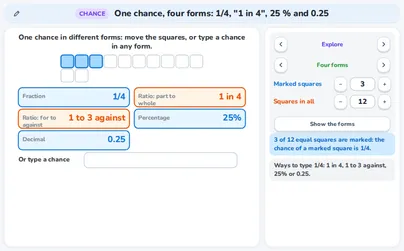
A chance tells how likely something is. 0 means that it cannot happen and 1 means that it is certain. In between, a chance is the part of the equal cases in which it happens. In Four forms you move the squares or type a chance and see it written in every form. The tab uses up to 20 squares.
Example
One of 4 equal squares is marked. The chance of a marked square is .
Fraction1/4
Rule

One chance, four forms

One chance can be written as a fraction, a ratio, a percentage and a decimal. They are the same number in different clothes. Type a chance in the box Or type a chance and press Show the forms: the application reads a fraction such as 2/8, a percentage, a decimal or a ratio and writes the chance in all the forms. A fraction is made as simple as possible: 2/8 becomes 1/4.
Example
A chance of 1/4 is written “1 in 4”, “1 to 3 against”, 25% and 0.25.
Fraction1/4Ratio: part to whole1 in 4Ratio: for to against1 to 3 againstPercentage25%Decimal0.25
Rule

Part to whole or for to against

A ratio can be written in two ways. “1 in 4” counts the cases for and the cases in all: 1 of 4. “1 to 3 against” counts the cases for and the cases against: 1 for and 3 against. The two describe the same chance, and the cases in all are the cases for plus the cases against. In Two ratio forms set the Cases for and the Cases against (1 to 9 each) and read all the forms.
Example
1 for and 3 against make cases in all. The chance is 1/4, which is “1 in 4”.
1 for · 3 againstRatio: part to whole1 in 4Ratio: for to against1 to 3 against
Watch out!

1 to 3 is not 1/3

A common mistake is to write “1 to 3 against” as the fraction 1/3. The 3 counts only the cases against. The cases in all are , so the chance is 1/4. The application has its own message for this trap when you type 1/3 for a chance of “1 to 3 against”.
Example
“1 to 3 against” is the chance . The fraction 1/3 is about 33.3%, a bigger chance.
Rule

The weather: days out of 100

A forecast “chance of rain 30%” means: on 30 of 100 days like this it rains. In Weather a grid of 100 days shows the forecast. Choose Day 1, Day 2 or Day 3, set the chance with Rain, day 1 (%) and the other two (0 to 100 in steps of 5) and type the Chance of no rain (%). Rain and no rain together are 100%.
Example
A forecast of 30% means 30 of 100 days with rain. The chance of no rain is .
Percentage30%Ratio: part to whole3 in 10
Special case

Impossible and certain

A chance of 0 (0%) means that it can never happen: with a forecast of 0% it cannot rain. A chance of 1 (100%) means that it is certain. No chance is below 0% or above 100%: the application says so when you type such a number.
Example
With 0 of 4 squares marked the chance is . With all 4 marked it is .
Tip

Which is likelier? Use one form

To compare chances that are written in different forms, change them all to one form, for example percentages. In Which is likelier? tap four chances from the smallest to the biggest. Choose one of the 8 sets with Set; afterwards the four chances are shown on a scale.
Example
Set 1: “1 in 20”, 4%, 0.06 and 1/15. In percent: 5%, 4%, 6% and about 6.7%. The order is .
3456781 in 204%0.061/15
Rule

My own bag: counters give the chance

A bag holds counters of two kinds. The chance of red is the number of red counters divided by all the counters. In My own bag the Target asks for a chance in one of the forms (8 targets). Set the Red counters and the Other counters (0 to 12 each) until the four forms show the target.
Example
The target is “1 in 5”. With 2 red and 8 other counters there are counters and the chance of red is , which is 1/5.
Fraction1/5Ratio: part to whole1 in 5Percentage20%
Tip

Typing a chance

The answer boxes read what you would write: a fraction, a percentage, a decimal or a ratio of your language. 2/8, 25%, 0.25 and “1 in 4” all give the same chance, and the decimal point and the decimal comma both work. Anything else cannot be read: the application then asks for a fraction, a percentage, a decimal or a ratio.
Example
Typed as 2/8, 25%, 0.25 or “1 in 4” the chance is the same → .
Definition

A percentage point

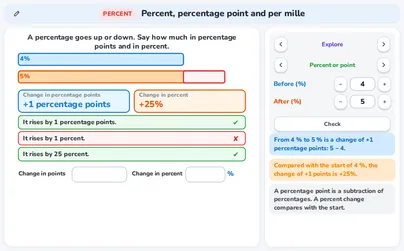
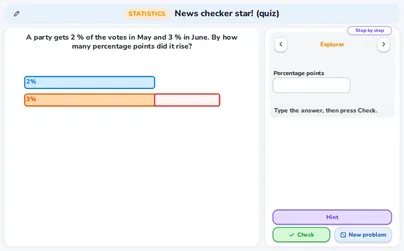
A percentage point is the difference between two percentages. When a share goes from 4% to 5% it rises 1 percentage point. In Percent or point set Before (%) and After (%) (1 to 60), see the two bars, type the Change in points and the Change in percent and press Check.
Example
From 4% to 5% → percentage point.
4%5%+1 percentage pointscompared with the start: +25%
Rule

The change in percent

The change in percent compares the change with the start: divide the change by the start and write the result as a percentage. The same rise of 1 point is a different change in percent when the start is different.
Example
From 4% to 5% the change is 1 point and the start is 4. , so the change is 25%.
Watch out!

A point is not a percent

A common mistake is to say “up 1 percent” when a share goes from 4% to 5%. “Up 1 percentage point” is right. “Up 1 percent” is wrong, because 1 percent of 4% is only 0.04 points. The application shows three sentences about the change and marks each one right or wrong. A share can also fall, and the two ways to say it then differ as well.
Example
From 20% to 15%: it falls 5 percentage points. , so it falls 25%. “It falls 5 percent” is wrong.
20%15%−5 percentage pointscompared with the start: -25%
Definition

Per mille

Per mille means out of 1 000, like percent means out of 100. One per mille is a tenth of a percent: 1 per mille = . In Per mille set the Per mille (1 to 100) and the Soup (g) (100 to 5 000 g) and type the salt in grams, the Per mille of the amount.
Example
A soup of 2 000 g holds 9 per mille salt → of salt. And 9 per mille is 0.9%.
Rule

Tax: the factor

A tax is added to the price. With a rate of 21% the price becomes 121% of the price without tax: the factor is 1.21. Price with tax = price without tax × 1.21. In Tax rates choose High rate: 21 % or Low rate: 9 %, set the Price (euro) and type the price. These rates are examples (the rules of 2026): check the current rates.
Example
A shirt of 50 euro without tax at the example rate of 21% → , so 60.50 euro. The tax is , so 10.50 euro.
Rule

Take the tax off again

To find the price without tax, divide by the factor: price without tax = price with tax ÷ 1.21. The tax is the difference of the two prices. Taking 21% off the price with tax is wrong, because that is 21% of a bigger number. Choose Price with tax is known in Tax rates to turn the question round.
Example
A price with tax of 121 euro at 21% → euro without tax and the tax is euro. Taking 21% off 121 gives , which is wrong.
Rule

A percent of a percent

To take a percent of a percent, multiply: a% of b% is a × b ÷ 100 percent of the whole. Percentages are not added. In A percent of a percent set the First percent, the Second percent and the Pupils in all (100 to 1 000), see both parts on one bar and type the Percent of all.
Example
40% of 500 pupils are in the choir → pupils. 30% of those play the piano → pupils. , so 12% of all. Adding gives , which is wrong.
Definition

Four levels of data

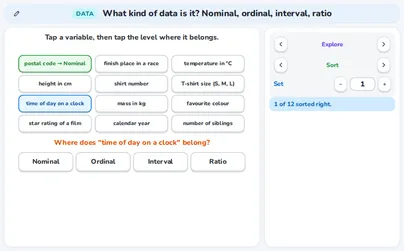
Data come in four levels, from the weakest to the strongest: nominal (names), ordinal (an order), interval (equal steps) and ratio (a true zero). Each level allows more than the one before. In Sort tap a variable and then the level where it belongs; every pick gets a reason. There are 24 variables in two sets of 12.
Example
Postal code: nominal. Finish place in a race: ordinal. Temperature in °C: interval. Height in cm: ratio.
Ratioheight in cmmode, median, mean, ×2Intervaltemperature in °Cmode, median, meanOrdinalfinish place in a racemode, medianNominalpostal codemode
Definition

Nominal: only names

A nominal variable has only names or labels, with no order: postal code, shirt number, favourite colour. You can count how often each name occurs and take the mode, the most frequent one. A mean or a median means nothing. In What can I calculate choose a dataset (8 datasets of 7 values), tap a summary and read what the level allows.
Example
Seven pupils name their favourite colour: red, blue, red, green, blue, red, yellow. Red appears 3 times, the most, so the mode is red. A mean of colours cannot be calculated.
Definition

Ordinal: an order

An ordinal variable has an order, but the gaps between the values are not known to be equal: finish place, T-shirt size, a star rating. Now the median, the middle value in order, makes sense, and the mode too. A mean does not: the gap between 1st and 2nd can be bigger than between 2nd and 3rd.
Example
The finish places of 7 runners are 3, 1, 4, 2, 5, 2, 6. In order: 1, 2, 2, 3, 4, 5, 6. The median is the fourth place in the list: 3.
Definition

Interval: equal steps

An interval variable has equal steps but no true zero: temperature in °C, calendar year, time of day. Now the mean makes sense, and so do differences. Ratios do not: 0 °C is a chosen point, not “no temperature”.
Example
The temperatures on 7 days are 12, 15, 9, 14, 18, 15, 11 degrees. The sum is and the mean is degrees.
Definition

Ratio: a true zero

A ratio variable has equal steps and a true zero, where 0 means none: height, mass, number of siblings, time. Now “twice as much” makes sense: you can divide two values. The level also allows everything that the levels before it allow.
Example
The numbers of siblings of 7 pupils are 1, 2, 1, 3, 2, 1, 4. The biggest is 4 and the smallest is 1 → , so the biggest is 4 times the smallest.
Watch out!

Zero changes the ratio

20 °C is not twice as warm as 10 °C. In °C the ratio is 2, but in °F it is 1.36 and in K it is 1.04: the ratio changes with the unit, so it means nothing. A mass keeps its ratio in kg, g and mg. In Zero set the First value and the Second value (1 to 100), choose Temperature or Mass and the unit, and watch the ratio.
Example
10 °C and 20 °C → . In °F these are 50 °F and 68 °F → . In K they are 283.15 K and 293.15 K → . Masses of 10 kg and 20 kg give 2 in every unit.
Special case

Survey scales: stars

A survey asks for 1 to 5 stars. Strictly this is ordinal: nobody knows that the steps are equal. Many surveys still take the mean, and the application names this usual practice. The median is always safe: it keeps the same answer when the labels change. In Survey scales set the number of answers for each star (0 to 10) and choose Labels 1, 2, 3, 4, 5 or Labels 1, 2, 3, 4, 10.
Example
There are 12 answers: 1, 2, 3, 4 and 2 answers for the stars 1 to 5. With the labels 1 to 5 the mean is . With the labels 1, 2, 3, 4 and 10 it is . The median stays 3.5 both times.
Tip

Which summary may I use?

Ask three questions about a variable. Is there an order? If not, it is nominal and only the mode is allowed. Are the steps equal? If not, it is ordinal and the median is allowed too. Does 0 mean none? If not, it is interval and the mean is allowed too; if yes, it is ratio and “twice as much” is allowed as well.
Example
Number of siblings: it has an order, equal steps and a true zero, so it is ratio: the mode, median, mean and “twice as much” are allowed. Shirt number: only names, so it is nominal: only the mode is allowed.
Rule

Percent of what?

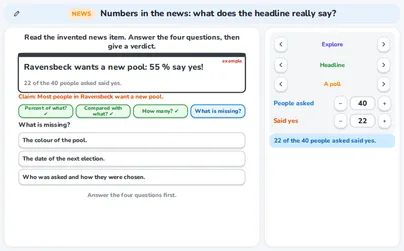
A percentage always belongs to a group, so ask first: percent of what? In Headline the application shows 4 invented news items, each with the label example. Every item has 4 questions of 3 options (Percent of what?, Compared with what?, How many? and What is missing?) and then a verdict.
Example
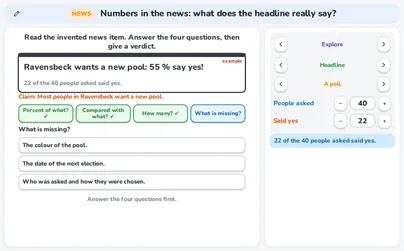
The headline says “Ravensbeck wants a new pool: 55% say yes!” Of the 40 people asked, 22 said yes → . The 55% is of the 40 people asked, not of the whole town.
exampleRavensbeck wants a new pool:55% say yes!22 of the 40 people asked said yes.? Cannot tell
Rule

How many are behind the number?

A small poll is not precise. The margin of a poll is about 100 divided by the square root of the number of people asked, in percentage points. The claim “most people want it” is supported only when the yes share minus the margin is still above 50%. It is not supported when the yes share plus the margin is below 50%. Otherwise we cannot tell. Set People asked (20 to 400) and Said yes to try it.
Example
22 of the 40 asked said yes: 55%. The margin is about 16 points → and . The 50% line lies in between, so we cannot tell. With 240 yes out of 400 the share is 60%, the margin is about 5 points and is above 50: supported.
Rule

A rise needs a base

“Up 50%!” sounds big, but it depends on the base. In the item about flu cases the claim “flu is spreading fast” is supported by a rise of at least 10 cases and at least 20%. A smaller rise out of small numbers cannot tell, and a fall is not supported. Set Cases last week (1 to 300) and Cases this week to try it.
Example
From 20 to 30 cases → more, and . That is at least 10 cases and at least 20%, so it is supported. From 2 to 3 cases is also +50%, but it is only 1 case more, so we cannot tell.
exampleFlu cases in Ravensbeck up50%!20 cases last week, 30 cases this week.✔ Supported
Rule

Mean or median?

A few very high values pull the mean up, but the median stays where it is. In the item about a wage the headline gives the mean of 7 wages. The claim “a typical worker earns the mean” is supported only when the mean lies within a tenth of the median. In Which number tells it choose the story Wages and a claim, then the number that fits.
Example
Six workers earn 2 200 to 2 700 a month and the boss earns 12 000. The sum is , the mean is and the median is 2 500. A tenth of 2 500 is , but the mean is above the median: not supported.
exampleThe average wage atCopperfield Ltd is 3814 amonth!Six workers earn 2200 to 2700 a month;the boss earns 12000.✘ Not supported
Rule

Total or rate?

A total counts, a rate compares. A big town has more thefts in total even when a bike is less likely to be stolen there. For “more likely” compare the thefts per 1 000 inhabitants. In Which number tells it the story Thefts lets you choose between the totals, the thefts per 1 000 inhabitants and the difference between the totals.
Example
Hartwell has 40 000 inhabitants and 120 thefts, Marlow has 10 000 inhabitants and 60 thefts. Per 1 000 inhabitants → and . The totals say , but the rate is higher in Marlow → . The claim about Hartwell is not supported.
exampleMore bike thefts in Hartwell:120 against 60 in Marlow!Hartwell has 40 000 inhabitants andMarlow has 10 000.✘ Not supported
Rule

Two headlines, one table

Two headlines can both be true for the same numbers: they stress different sides. A neutral sentence gives both numbers and the total. In Two headlines, one table choose a table (Swimming test, Waste bags or Buses), set Passed, tap the neutral sentence and type the answer to How many did not pass?.
Example
Of 20 pupils, 18 passed the swimming test. “90% passed!” and “10% did not pass!” are both true → and , . The neutral sentence is “18 of 20 pupils passed; 2 of 20 did not pass.”
Rule

What is missing?

A number alone often says little. Ask for four things: the base (percent of what), the period (in what time), the unit (feet or metres, euro or tickets) and the group (for whom, who was asked). In Missing context read an invented story (8 stories, set with Story) and tap what is missing.
Example
“The new bridge is 120 long!” The unit is missing: 120 feet is only about 37 metres , and 120 metres is more than three times as long. “Sales at the Dune Café are up 30%!” The base is missing: 10 cakes a day became 13, which is of a small base.
exampleSales at the Dune Café are up30%!Before: 10 cakes a day. Now: 13 cakes aday. The 30% is of a small base.
Rule

The verdict

After the four questions give a verdict: supported, not supported or cannot tell. The application uses simple rules: for a poll, the yes share minus the margin must be above 50%; for a rise, at least 10 cases and at least 20%; for a wage, the mean within a tenth of the median; for two towns, the thefts per 1 000 inhabitants. “Cannot tell” is a good answer when the numbers are too small.
Example
A poll of 100 people with the margin of about 10 points. 60 say yes → is not above 50, so we cannot tell. 70 say yes → is above 50, so it is supported.
Tip

My opinion: which rows support it?

In My opinion choose a table (Pool visitors, Bus lines or School lunch) and tap a statement. Then tap the rows of the table that support it. Some statements have no row that supports them: the application tells which number is missing, and that is a good answer. There are 3 tables with 4 statements each.
Example
Pool visitors: 120 on a school day, 300 on a weekend day and 450 on a holiday day. “The pool is busier at the weekend than on school days” is supported by the rows 120 and 300, because . “The pool is too small at the weekend” has no row: no number says how many visitors fit.
Tip

The quiz: all four together

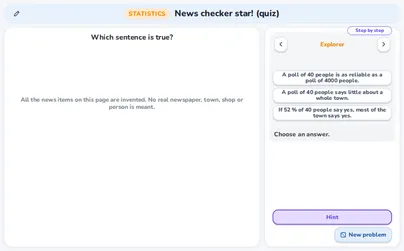
The Quiz mixes questions of the four applications: chances in different forms, percentage points and per mille, tax, the level of a variable and the verdict on a headline. Choose Starter, Explorer or Champion. Every question is new, you type a number or choose an answer, and the hint ladder helps when you are stuck. Your score stays in your browser.
Example
A question: the forecast says chance of rain 35%. What is the chance of no rain, as a percentage? The answer is .
Tip

The class round

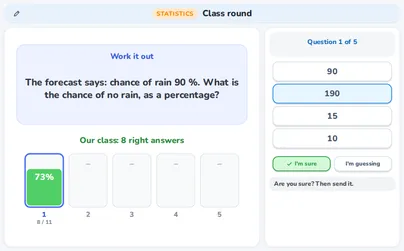
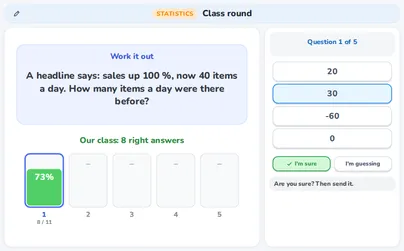
In the class round the whole class answers 5 questions, each pupil on their own screen: a definition, a rule, a true-or-myth statement and two questions with new numbers. The bank holds 14 questions and 4 generators make new numbers. Every wrong option has a name for the mistake, so the teacher sees which mistake was made most often.
Example
One question of the bank: 30% of 40% of a group is 12% of the group, because . The wrong option 70% adds the two percentages.
Tip

Keys, what is sent and what is invented

Tab goes to a card, chip, row or button, Enter (or Space) chooses it, the arrow keys change a slider and Esc closes this page. Nothing you type is sent anywhere. Every news item is invented and carries the label example; the situations are original, with no real newspaper, brand, person or event. The tax rates are examples: check the current ones.
Example
Try it: press Tab until a card has a frame, then press Enter to choose it. With a slider, press an arrow key.

Exercises

A bag holds 1 red counter and 3 other counters. Write the chance of red in the four forms: as a fraction, as a ratio, as a percentage and as a decimal. Easy
Show solution
All the counters → .
Fraction: 1/4. Part to whole: “1 in 4”. For to against: “1 to 3 against”.
Percentage and decimal → .
Ratio: part to whole1 in 4Ratio: for to against1 to 3 againstPercentage25%Decimal0.25
Answer → 1/4, “1 in 4”, “1 to 3 against”, 25% and 0.25
Check → counter.
The forecast says: chance of rain 35%. What is the chance of no rain, as a percentage? Easy
Show solution
Rain and no rain together are 100%.
The chance of no rain is .
Answer → 65%
Check → .
A share goes from 8% in May to 11% in June. Give the change in percentage points and the change in percent. Easy
Show solution
Points: subtract → .
Percent: divide the change by the start → .
8%11%+3 percentage pointscompared with the start: +37.5%
Write it as a percentage → .
Answer → 3 percentage points and 37.5%
Check → .
Give the level of each variable and the most that you can calculate: postal code, finish place in a race, temperature in °C and height in cm. Easy
Show solution
A postal code is only a name: nominal, so only the mode.
A finish place has an order but unequal gaps: ordinal, so the median.
A temperature in °C has equal steps but no true zero: interval, so the mean.
A height has a true zero: ratio, so “twice as much” too.
Ratioheight in cmmode, median, mean, ×2Intervaltemperature in °Cmode, median, meanOrdinalfinish place in a racemode, medianNominalpostal codemode
Answer → nominal (mode), ordinal (median), interval (mean), ratio (twice as much)
Check → every level allows what the level before it allows.
A poll asks 50 people and 30 say yes. What percentage is that? Easy
Show solution
Divide the part by the total → .
Write it as a percentage → .
Answer → 60% of the 50 people asked
Check → .
A chance is “2 to 3 against”. Write it as a fraction and as a percentage. Medium
Show solution
2 cases for and 3 against → cases in all.
The chance is 2 of the 5 cases: 2/5.
As a percentage → .
Answer →
Check → the same chance is “2 in 5”. The fraction 2/3 would be wrong.
Put the chances in order from the smallest to the biggest: “1 in 8”, 0.15, 12% and 1/10. Medium
Show solution
Write all four as percentages → , , 12% and .
Order them → .
9101112131415161 in 80.1512%1/10
Answer → 1/10, 12%, “1 in 8”, 0.15
Check → .
A soup of 3 000 g holds 7 per mille salt. How many grams of salt is that, and what percent is 7 per mille? Medium
Show solution
Per mille means out of 1 000 → .
For 7 per mille → .
7 per mille is .
Answer → 21 g of salt; 7 per mille is 0.7%
Check → → 10 per mille is 1%, so 7 per mille is 0.7%.
A shirt costs 40 euro without tax. With the example rate of 21%, what is the price with tax and how much of it is tax? Medium
Show solution
The factor is .
The price with tax is , so 48.40 euro.
The tax is , so 8.40 euro.
Answer → 48.40 euro, of which 8.40 euro is tax
Check → the tax is 21% of 40 → .
Seven pupils rate a film with 1 to 5 stars: 4, 5, 2, 5, 3, 5, 1. Give the median and the mode. Is the mean safe to use? Medium
Show solution
Put the ratings in order: 1, 2, 3, 4, 5, 5, 5.
The median is the middle one, the fourth: 4.
The mode, the most frequent rating, is 5.
A 1 to 5 scale is ordinal: the median is always safe, but the mean needs equal steps and nobody knows that they are equal.
Answer → median 4, mode 5; the median is safe, the mean is not
Check → 3 ratings lie below 4 and 3 ratings lie above it, so 4 is in the middle.
In the flu item the cases go from 40 to 50. Is “flu is spreading fast” supported? Medium
Show solution
The cases rise by .
In percent → .
That is at least 10 cases and at least 20%: supported.
Answer → supported
Check → from 50 to 59 the rise is only , below 10: then we cannot tell.
A party has 20% of the votes in May, 15% in June and 20% again in July. Give the change in points and in percent from May to June and from June to July. Hard
Show solution
May to June → points. In percent → , so it falls 25%.
June to July → points. In percent → , so it rises about 33.3%.
15%20%+5 percentage pointscompared with the start: +33.3%
The points are equal but the percentages are not: the start is different.
Answer → −5 points and −25%, then +5 points and about +33.3%
Check → and is about 5 as well.
A price with tax is 18.15 euro at the example rate of 21%. What is the price without tax and how much of it is tax? Hard
Show solution
The factor is 1.21, so the price without tax is .
The tax is the difference → .
Taking 21% off 18.15 would be wrong: that is 21% of a bigger number.
Answer → 15 euro without tax and 3.15 euro tax
Check → .
Of the 800 pupils of a school, 25% go by bike and 40% of those pupils are girls. What percent of all the pupils is that, and how many pupils? Hard
Show solution
By bike → pupils.
Girls among them → pupils.
Percent of all → .
Answer → 10%, which is 80 pupils
Check → . Adding the percentages gives , which is wrong.
A poll of 100 people has a margin of about 10 points. Is “most people want it” supported when 60 say yes? And when 70 say yes? Hard
Show solution
The claim is supported only when the yes share minus the margin is above 50%.
60 say yes → , which is not above 50. is above 50 too, so we cannot tell.
70 say yes → , which is above 50: supported.
Answer → 60 yes: we cannot tell; 70 yes: supported
Check → with 61 yes → is above 50, so it is supported.
Hartwell has 40 000 inhabitants and Marlow has 10 000. The news says there were 90 bike thefts in Hartwell and 30 in Marlow. Is “a bike is more likely to be stolen in Hartwell” supported? Hard
Show solution
Compare the thefts per 1 000 inhabitants, not the totals.
Hartwell → . Marlow → .
exampleMore bike thefts in Hartwell:90 against 30 in Marlow!Hartwell has 40 000 inhabitants andMarlow has 10 000.✘ Not supported
→ the rate is lower in Hartwell.
Answer → not supported
Check → the totals say , but Hartwell has 4 times as many inhabitants and only 3 times as many thefts → and .
Are you a teacher?

Start live lessons with these applications for your whole class. Free to try for one month.

Try it free

Fits these school years

IB (MYP, Diploma): MYP 1, MYP 2, MYP 3

Cambridge International: Lower Secondary, stage 7, Lower Secondary, stage 8, Lower Secondary, stage 9, IGCSE

Netherlands: Year 1, Year 2, Year 3 (havo, vwo), Havo · Mathematics A, Vwo · Mathematics A, Vwo · Mathematics C, Groep 8

Türkiye (MEB): Year 6 (MEB), Year 7 (MEB), Year 8 (MEB), Year 9 (MEB)

England (GCSE, A Level): Year 7, Year 8, Year 9, Year 10 (GCSE)

USA (Common Core): Grade 6, Grade 7, Grade 8, Algebra 1

What the applications of this topic teach 7 applications

One chance, four forms: 1/4, "1 in 4", 25 % and 0.25

  • Writing one chance as a fraction, ratio, percentage and decimal
  • Telling “1 in 4” from “1 to 3 against”
  • Reading a weather forecast as days out of 100
  • Ordering chances written in different forms

Percent, percentage point and per mille

  • Telling a percentage point from a percent change
  • Working out per mille of an amount
  • Adding a tax to a price with a factor and taking it off again
  • Taking a percent of a percent

What kind of data is it? Nominal, ordinal, interval, ratio

  • Knowing the four levels of data: nominal, ordinal, interval, ratio
  • Saying which summary a level allows
  • Knowing why 20 °C is not twice as warm as 10 °C

Numbers in the news: what does the headline really say?

  • Asking “percent of what?”, “compared with what?”, “how many?”
  • Judging an invented headline: supported, not supported, cannot tell
  • Choosing the number that fits a claim: mean or median, total or rate

Numbers in the news, primary school edition: what does the headline really say?

  • Asking “percent of what?”, “compared with what?”, “how many?”
  • Judging an invented headline: supported, not supported, cannot tell
  • Choosing the number that fits a claim: mean or median, total or rate

News checker star! (quiz), primary school edition

  • Answer questions on the application of this edition: percent of what, compared with what, how many and what is missing in a number in the news.

Class round, primary school edition: the whole class at once

  • I know what the base of a percentage is and that a percentage without a base tells little.
  • I know that a rise of 30% of a very small number can still be a very small change and that a big number in a headline is not always important.
  • I know how to judge a poll: ask how many people were asked and who they were.