İnteraktif Dersler

Averages and range: mean, median, mode, range

Lecture notes

Definition

The mean as a fair share

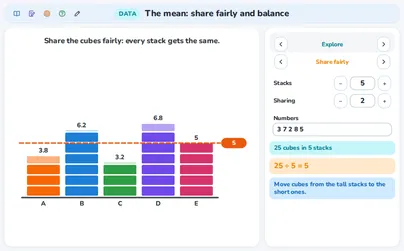
Share all the cubes out fairly: every stack gets the same. That number is the mean.
1384
Example
Stacks of 2, 4 and 9 cubes: each
2495
Definition

The mean as the balance point

Put a pivot under a beam with the numbers on it. It balances at the mean: the pulls to the left and to the right are equal.
013489314
Example
Numbers 2, 4 and 9, mean 5:left , right
0245910314
Rule

Total ÷ how many

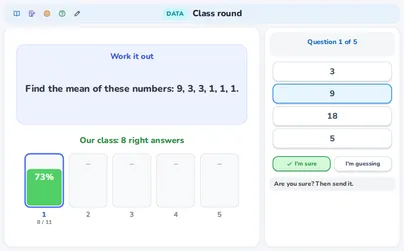
Mean = the total of the numbers ÷ how many numbers there are: . It does not have to be a whole number, and it does not have to be in the list.
352616÷44444
Example
6841028÷47777
Rule

The mean backwards

Mean × how many = the total: . Take away the numbers you know to find a missing number.
555×347?15
Example
Mean 6 of 4 numbers, known 5, 7 and 4:,
6666×4574?24
Definition

Median: an odd number of numbers

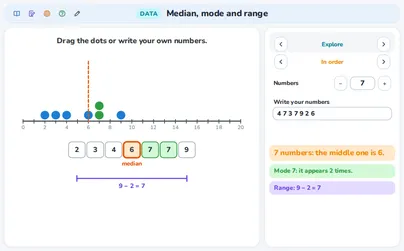
Put the numbers in order first, from smallest to largest. The median is the middle one.
147810
Example
9, 3, 12, 5, 20In order: 3, 5, 9, 12, 20: median 9
93125203591220
Definition

Median: an even number of numbers

With an even count there are two middle numbers. The median is halfway between them: .
13795
Example
246105
Definition

Mode: the most common

The mode is the number that appears most often. There can be two modes, and no mode when every number appears equally often.
0246
Example
2, 3, 3, 5, 5: modes 3 and 51, 2, 3: no mode
135123
Definition

Range: how spread out

Range = the largest number − the smallest number: . A small range means the numbers are close together.
02108
Example
3, 9, 4, 12
03129
Tip

Which average fits?

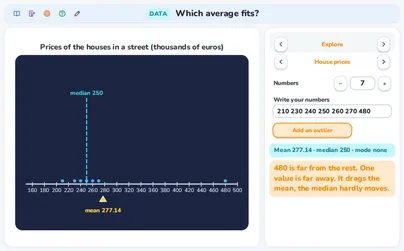
Numbers close together: the mean. One far away number (an outlier) or a skewed set: the median. Words and categories, such as colours: only the mode.
010203040
Example
Prices 10, 11, 12, 13, 90:mean but median 12 is typical
020406080100
Rule

Adding one more number

One more number changes the total and the count. New mean = new total ÷ new count: . The median moves by at most a step in the ordered list.
22283
Example
4 numbers, mean 5, one more number 10:
5555106
Rule

Every number + k

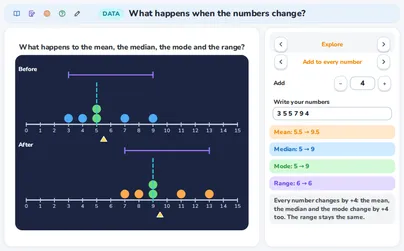
When you add the same k to every number, the mean, the median and the mode go up by k. The range stays the same.
0510505105+3
Example
3, 5, 10 and add 2: 5, 7, 12mean , range
0714707147+2
Rule

Every number × f

When you multiply every number by f, the mean, the median, the mode and the range are all multiplied by f.
0510305106×2
Example
3, 5, 10 times 2: 6, 10, 20mean , range
0102070102014×2
Rule

The mean from a frequency table

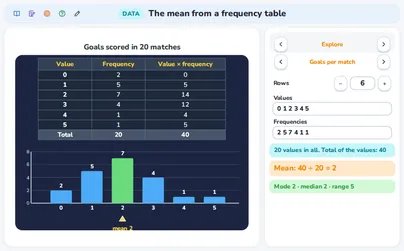
Multiply every value by its frequency, add these products, then divide by the total frequency (how many values there are): .
1234
Example
Values 1, 2, 3 with frequencies 2, 5, 3:
123
Rule

Median and mode from a table

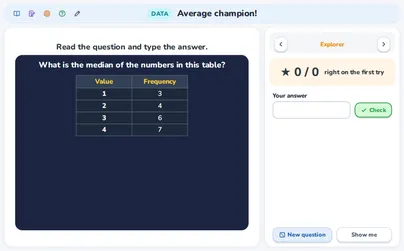
The mode is the value with the highest frequency. For the median count to the middle of all the values, using the running total of the frequencies.
12312345678910
Example
Frequencies 2, 5, 3 (10 values): mode 2The 5th and 6th are both 2: median 2
12312345678910
Definition

Grouped data and midpoints

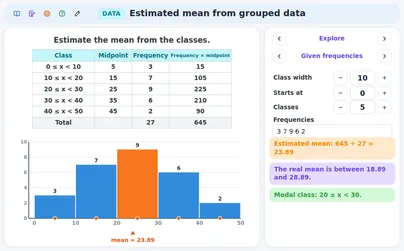
When values are put in classes we do not know the exact values. We use the midpoint of every class instead: (lower border + upper border) ÷ 2: .
012345010203051525
Example
Class Midpoint
0123456102015
Special case

Why only an estimate

The real mean lies between the mean found with all lower borders and the mean found with all upper borders. The midpoints give an estimate in between.
0813182081813
Example
Classes and , frequencies 4 and 6:between and , estimate
0611162061611
Definition

Modal class and median class

The modal class has the highest frequency. The median class is the class that holds the middle value: add up the frequencies from the first class until you pass the middle.
0246010203061015
Example
Frequencies 4, 6, 5 (15 values):modal class 2nd; the 8th value: , 2nd class
0246010203041015
Rule

Compare two data sets

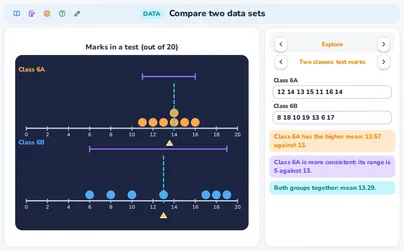
Compare an average and the range. The smaller range is more consistent: the numbers are closer together.
05102A05108B
Example
A: 5, 6, 7 and B: 2, 6, 10Both mean 6; range and : A is more consistent
06122A06128B
Watch out!

Two groups together

Do not just average the two means. Multiply each mean by its group size, add the totals and divide by all the numbers: .
0246824480410
Example
4 pupils with mean 6 and 6 pupils with mean 8:
0246814024002050
Tip

Link: tally, frequency and charts

Tally marks and frequency tables are in Data and questions; drawing and reading charts is in Charts and graphs. Here the table and the chart are the data for an average.
122533
Example
Tally ||||| ||| is frequency 8value 3 with frequency 8 counts
3824
Tip

Link: more about spread

Quartiles and box plots, histograms and standard deviation come in later subgroups. Here the only measure of spread is the range.
Example
Same range , different spread:2, 5, 5, 10 and 2, 3, 9, 10
0612806128
Tip

Link: fractions, decimals and ratio

A fair share is a division, so the mean can be a fraction or a decimal. Two groups of different sizes are put together with a ratio of their sizes.
7÷23½3½
Example
Groups of 4 and 6: ratio 2 : 3
10÷42½2½2½2½

Exercises

Five children have 2, 3, 3, 5 and 7 euros. They share the money fairly. How much does each get? Easy
23357
Show solution
Add the money:
Divide by the 5 children:
233574
Answer → 4 euros each (the mean)
Add first, then divide by how many: .
Find the median and the range of 9, 3, 12, 5, 20, 7. Easy
93125207
Show solution
In order: 3, 5, 7, 9, 12, 20
35791220
6 numbers: halfway between 7 and 9:
357912208
Range:
3579122017
Answer → median 8, range 17
Order the numbers before you look for the middle.
The marks of 4 pupils are 12, 14, 15 and 11. A fifth pupil gets 18. What is the new mean? Medium
1214151118
Show solution
Old total:
1214151152
New total:
121415111870
New mean:
121415111870÷51414141414
Answer → 14
Use the new total and the new count: .
Shoe sizes 36, 37, 38 have the frequencies 4, 3, 3. What is the mean? Medium
363738
Show solution
Products: , ,
Total:
Frequencies: , so
363738
Answer → 36.9
Divide by the total frequency, not by the number of rows: .
Class A has 20 pupils with mean 7. Class B has 30 pupils with mean 8. What is the mean of both classes together? Hard
0246802050
Show solution
Totals: and
0246814024002050
Together: for pupils
Mean:
0246814024002050
Answer → 7.6, not 7.5
Weight each mean by its group size: .
Classes 0 ≤ x < 10, 10 ≤ x < 20, 20 ≤ x < 30 have the frequencies 3, 5, 2. Estimate the mean. Hard
0123453520102030
Show solution
Midpoints: 5, 15 and 25
012345352010203051525
Products: , ,
Total: , values:
Estimate:
Answer → about 14
Use the midpoints, not the borders, and divide by the number of values: .
Are you a teacher?

Start live lessons with these applications for your whole class. Free to try for one month.

Try it free

Fits these school years

IB (MYP, Diploma): PYP, MYP 1, MYP 2, MYP 3

Cambridge International: Primary, stage 5, Primary, stage 6, Lower Secondary, stage 7, Lower Secondary, stage 8, Lower Secondary, stage 9, IGCSE

Netherlands: Groep 6, Groep 7, Groep 8, Year 2, Year 3 (havo, vwo), Havo · Mathematics A, Vwo · Mathematics A, Vwo · Mathematics C

Türkiye (MEB): Year 5 (MEB), Year 6 (MEB), Year 7 (MEB), Year 8 (MEB), Year 9 (MEB), Year 10 (MEB)

England (GCSE, A Level): Year 5, Year 6, Year 7, Year 8, Year 9, Year 10 (GCSE), Year 11 (GCSE)

USA (Common Core): Grade 5, Grade 6, Grade 7, Algebra 1, Grade 8

What the applications of this topic teach 8 applications

The mean: share fairly and balance

  • Sharing stacks of cubes fairly to find the mean
  • Finding the balance point of a beam with weights
  • Calculating the mean as total ÷ how many
  • Using the mean backwards to find a missing value

Median, mode and range

  • Ordering numbers and finding the median
  • Finding the mode: two modes or none are possible
  • Finding the range: largest minus smallest

Which average fits?

  • Finding the mean, median and mode and choosing the one that fits
  • Seeing that an outlier pulls the mean but hardly the median
  • Knowing that only the mode works for categories
  • Finding the new mean and median when a value is added

What happens when the numbers change?

  • Knowing that adding k to every number adds k to the averages
  • Knowing that multiplying every number by f multiplies averages and range
  • Working backwards for a target mean or range

The mean from a frequency table

  • Reading a frequency table for the total of values
  • Finding the mean from a frequency table
  • Finding the mode, median and range from a frequency table

Estimated mean from grouped data

  • Finding the midpoint of a class
  • Estimating the mean from grouped data
  • Finding the modal class and the class containing the median
  • Explaining why grouped data give only an estimate

Compare two data sets

  • Comparing two data sets by mean, median and range
  • Knowing that a smaller range means a more consistent group
  • Finding the mean of two groups put together

Averages in everyday life

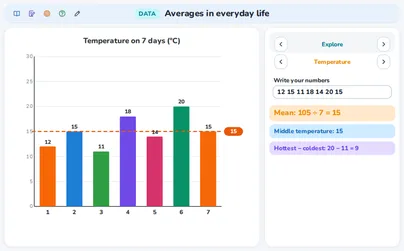
  • Finding the fair share of pocket money
  • Finding the mode of the goals of a team
  • Finding the middle score of quiz scores
  • Choosing the average that fits a real situation